

Representing the Future in an Aging Europe: The Politics of Demographic Change
The project has three primary objectives: 1. Drafting a Theory of Generational Political Pluralism by developing a model of inter-temporal political decision-making under the conditions of demographic change. 2. Providing novel and robust empirical evidence about the effects of demographic change on generational political pluralism in Europe and beyond. 3. Offering policy recommendations that focus on the potential of electoral reforms for ensuring generational political pluralism.
About the research project
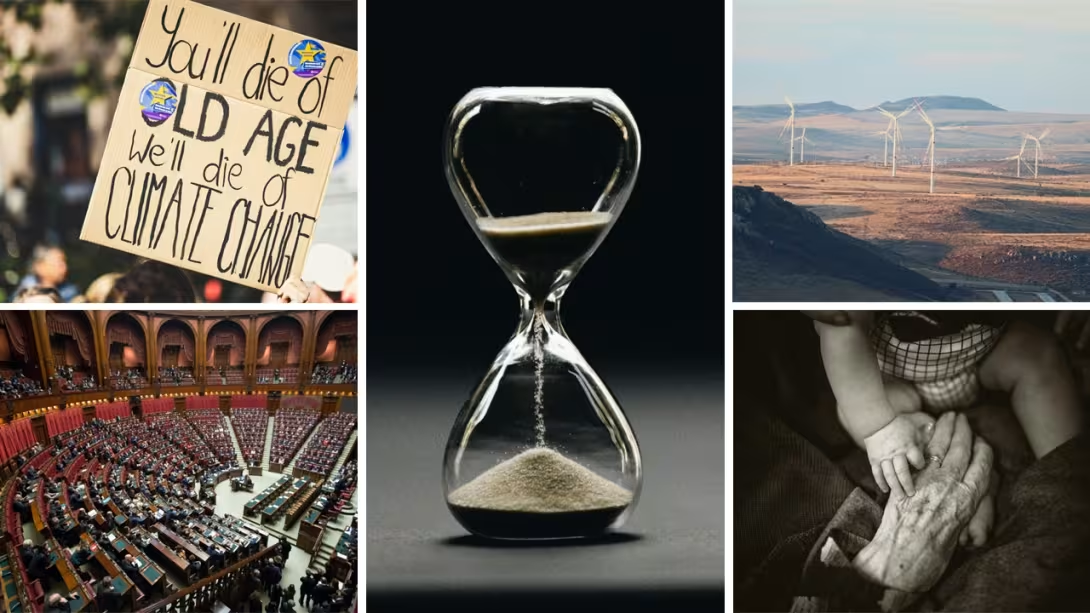
Demographic change is a key challenge for European economies, labour markets, and welfare systems. But it also has important implications for representative democracy: The parallel trends of low birth rates and increasing life expectancy cause the share of senior citizens to grow constantly. Today, people over 65 years of age represent 20% of European populations and 28% of electorates. They also participate in voting at much higher rates than young people do.
Furthermore, young people are practically absent from formal political decision-making, with only 5% of members of parliament (MPs) in Western Europe being under 30 years old. While young people will eventually obtain the right to vote and will have the chance to participate in political decision-making in the future, they are overproportionally affected by a number of political decisions that are being made today, especially in policy areas like climate, housing, or reproductive rights.
“Representing the Future” is situated at the intersection of political economy and political behavior. It addresses a striking tension between the steady aging of European electorates and the increasing necessity for long-term-oriented policy outcomes. On the one hand, effective democratic representation requires responsiveness towards older voters’ preferences. On the other hand, this can lead to an ineffective representation of young and future generations’ interests, as they are both a numerical minority and have fewer possibilities for electoral participation.
The project introduces the concept of Generational Political Pluralism (GPP), suggesting that a generationally pluralistic society should consider both the contemporary and long-term effects of policy decisions. To assess the impact of demographic change on GPP in Norway, Europe, and beyond, the project investigates generational cleavages in two integral parts of policymaking: public opinion and political representation.
Two interconnected work packages will (i) test how age, generation, and period affect generational cleavages in public opinion and (ii) compare and explain how the preferences of citizens belonging to different generations are represented by political decision-makers. The empirical analyses draw on a combination of observational, behavioral, and experimental data and will use a range of innovative methods to make descriptive and causal inferences.
People
Project manager
Jana Birke Belschner Project leader
Project members
Idunn Nørbech Post Doc
Arnt Bastian Mjærum PhD candidate
Silje Løseth PhD candidate
Mari Lien Børseth Research assistant
Contact
Jana Birke Belschner
Researcher, TMF Starting Grant Fellow
Department of Comparative Politics
- Phone number
- +47 94 98 50 98
- Emails
- jana.belschner@uib.no
