

And this is how a new Norwegian research community on menopause was formed
It felt like witnessing a historic moment when the KLAR project invited researchers to a national network day in Bergen in November. You know—the grainy moments when a small group of pioneers is captured on film. This time, it was the emerging academic research community on menopause in Norway.
Published:

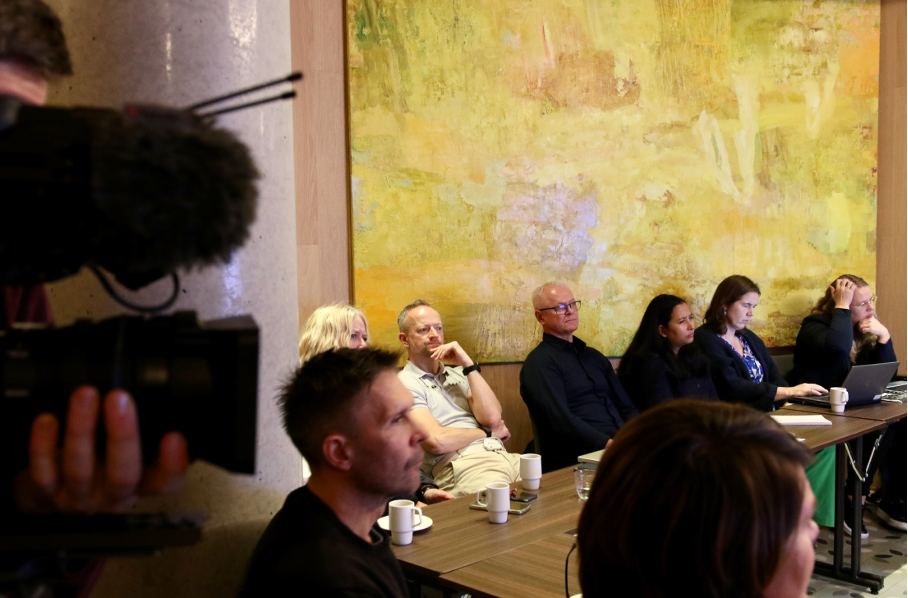
No one is looking at the camera. Everyone is focused on what lies ahead—on research yet to come. Yes, there was a sense of history in the air when the women behind the KLAR project at the University of Bergen gathered the still modest, but steadily growing, Norwegian research community on menopause and perimenopause for a national network day.
The sensitive topic of unavoidable bodily transitions experienced by many women between approximately ages 35 and 65 has been so undercommunicated and invisible in the current research landscape that when 22 people (4 men and 18 women) sat in a horseshoe formation in a conference room at Hotel Zander K in Bergen, introducing themselves one by one, it truly felt like the beginning of something new.
“This is a big day for Norway,” said Professor Silje Mæland once everyone had taken their seats. She laughed a little, everyone laughed—but she meant it, too.

A milestone for menopause research in Norway
Mæland emphasized that the network meeting represents an important milestone for menopause research in Norway. Both the 2023 Norwegian Official Report (NOU) and the 2025 report on working life and women’s health explicitly mention menopause, calling for contributors who can help build bridges between researchers—and between research and the general public.
The KLAR project has taken on that responsibility, something that was also praised by Bergen’s Lord Mayor, Christine Meyer, from the orange auditorium stage at the University of Bergen during DRIV’s major women’s health conference the day before.
“What we have surprisingly achieved today is to bring together research environments from across Norway—to get to know one another, to talk, and to generate new ideas. We have broken down the walls between universities and university colleges so that we can move forward hand in hand rather than as competitors. This is crucial for sharing knowledge and supporting one another nationally. We are already far behind—but now things are happening,” said Mæland, adding that roughly half of Norway’s menopause research community was gathered in the room.
“I can’t unsee what I’ve seen”
Along the tables sat a social anthropologist who herself had been unable to remain in work when she entered menopause, several physicians, biologists, social scientists, philosophers, psychologists, statisticians, nurses—and a male manual therapist who remarked:
“Now that I understand how many more symptoms menopause can involve for many women, beyond just hot flashes, I can’t unsee what I’ve seen and heard,” said Kjartan Fersum.
“I love menopause. I love women’s health,” said midwife and PhD candidate Anita Prante.
“And I’ve been eyeing the KLAR project for a long time—so the two of us are going to become best friends,” said NORCE researcher Heidi Marie Meling, looking across the room at KLAR team member and Professor at Western Norway University of Applied Sciences, Anette Fagertun.
Tips, reflections, wishes, constructive criticism, and opinions were shared. People asked, “May I interpret you a bit further?” and heard the answer, “Yes—go ahead!” Over soft bao buns and salmon rolls, several relatively young researchers and PhD candidates met for the first time—among them women in their thirties who have not yet experienced menopause themselves, but who have seen many women around them suffer in silence.
What if beets could help?
Anne Lovise Nordstoga, Associate Professor at NTNU, has found her place in this emerging landscape. She is now researching musculoskeletal pain in connection with menopause. Meanwhile, 430 kilometers further southwest at Western Norway University of Applied Sciences, former elite athlete Ann-Katrin Grotle is pondering beetroot juice—a nitrate-rich supplement—and whether it might improve cardiovascular health in inactive postmenopausal women.
“What if beets could lower blood pressure and increase blood flow for women of a certain age?” Grotle asks, as the room listens attentively to the presentation of her latest research.
“I had never really considered gender and hormones as a lens for understanding sex differences before, so this has truly been an eye-opener,” says Nordstoga, who in August launched a project on musculoskeletal pain among what she and Professor Lene Aasdahl call “women in midlife.”
“Musculoskeletal pain tops the list of conditions affecting women in midlife, far more so than men. This difference is known. It affects the most people and costs society the most,” Nordstoga and Aasdahl explain in their presentation.

There are no Norwegian studies on menopause!
Shortly after the turn of the millennium, menopause became almost invisible in academia. Mæland notes, however, that many women used hormone therapy in earlier decades, and that physicians spoke more openly about menopause from the 1950s until the infamous WHI study was published in 2002.
“For the past 25 years, there has been silence in Norway. That is precisely why today is a milestone in a Norwegian context. Imagine—there are no studies on menopause in our country. There is not a single Nordic study from the past ten years examining how menopause affects women’s working lives. Not one. So the work starts now, and we are ensuring that all parties are brought together,” says Mæland.
Her colleague, KLAR project leader Inger Haukenes, nods in agreement.

Grieg Foundation support raises the research standard
“Thanks to the funding we have received from the Grieg Foundation, we can turn the volume back up and take on a responsibility that no one in Norway has taken before—but which is urgently needed,” says Haukenes.
How has the support from the Grieg Foundation helped you?
“It has enabled us to involve researchers with exceptionally high expertise in menopause and related fields. This means that the research we are now conducting—and which will be published during 2026—will be of high quality and internationally relevant. We have also been able to prioritize dissemination, which is uncommon in large research projects. This has allowed us to reach the general public, businesses, and organizations. And knowledge about menopause has reached individual women—which we believe is the most important outcome of all,” Haukenes explains.
An atypical networking day in academia
What did this gathering mean for you, Grotle and Nordstoga, who met for the first time today?
“I think it is extremely important because it’s about coming together and starting discussions on how we can work more interdisciplinarily across research environments in Norway. We all have different expertise, and by collaborating we can achieve more. Menopause is complex, with many contributing factors. That’s why it’s crucial to bring different disciplines together to discuss challenges and find solutions,” says Ann-Katrin Grotle (HVL).
“You can only get so far working alone. To truly move research forward, collaboration is essential. That’s why we are grateful that KLAR took the initiative for this network meeting and for how inclusive they have been. They have set a strong example of how regional and national expertise can be mobilized,” says Anne Lovise Nordstoga (NTNU).

As the day comes to an end, thoughts turn to an even larger network gathering—and possibly a future conference. Professor Silje Mæland is pleased. And surprised, she admits.
“Yes, I’m actually a little surprised by the strong willingness and generosity people have shown in sharing and contributing. We often hear about sharp elbows in academia and competition for funding, but here we are lifting new knowledge together. And we are doing it—perhaps as women often do—in community. So this day has been somewhat atypical,” Mæland says.
“Inviting a national research community to a gathering like this is not common. That’s precisely why it matters. And why it’s fun.”