

Hope, science and summer research school
“There is hope in science and research”, said Rector Margareth Hagen in her welcome address to the one hundred PhD candidates from more than thirty countries taking part in the seventeenth Bergen Summer Research School.
By: Tord K. Rø
Published: (Updated: )

Young researchers filled the hall at Nygårdsgaten 5 early Monday morning to kick off two intense weeks of coursework, cross-disciplinary problem-solving and many social activities. The buzz and small talk of the crowd of people felt more like that of a reunion than a research school where strangers meet for the first time.
The participants come from as far away as Fiji, Japan, and the Philippines in the East; to Colombia, USA and Canada to the West; and Brazil and South Africa to the South.
They all share an interest in how education can help prepare the next generation to meet the many challenges facing the world.
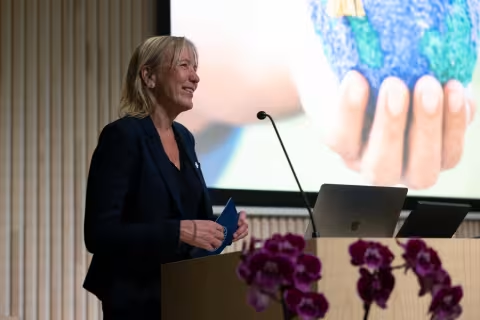
“The world needs more sharing and collaboration, and we need to get to know each other across the globe,” said Rector Hagen in her opening speech.
She pointed to Europe’s youth who, despite much progress in recent generations, seem more negative about their future than ever, with an increasing perception of inequality. A recent report (external link) shows that 52 percent of the sixteen- to twenty-six-year-olds fear they will be worse off than their parents.
“This gloomy outlook has worsened over the past decade. There is reason to worry,” she said and emphasised the need for hope.
“This is the reason why we together with the other academic institutions in Bergen launched Bergen Summer Research School in 2008. With this summer research school, we aim to create in inter-disciplinary and international arena for you, young researchers who care about global challenges, to work together and develop as researchers.”
Higher education as the key enabler
Director of Global Challenges at UiB, Simon Øverland, added a new conundrum—Artificial Intelligence, to Rector's list of global challenges: increasing inequality, persistent poverty, escalating polarisation, conflicts and war.
“Rapid technological shifts and AI keep knocking on our doors, offer us possibilities and demand new responses,” he said.
“Our regions and countries are affected at different scale and strength, but everywhere education remains one of the key tools for us to face all this. It helps us critically engage with all the Sustainable Development Goals and it helps us craft the content of a common agenda beyond the year 2030.”
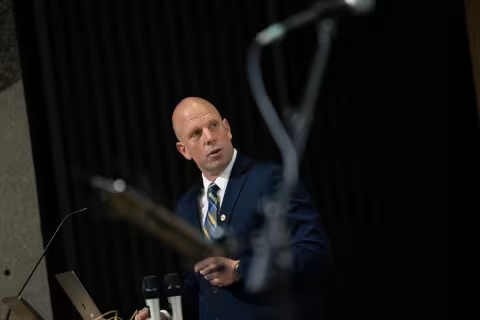
"Higher education is a key enabler for all the Sustainable Development Goals. The students we educate today will shape policies and action far beyond our current set of goals,” said Simon Øverland.
Inter- and transdisciplinary approaches
“Single disciplines can rarely cover all aspects of complex problems. In education we therefore need to make sure that our programmes build the right and specialised skills for each and all the disciplines.”
He emphasised the need those specialised skills, but also argued for the need to offer something for those of us that are willing to move across the disciplines.
“This need for a mix between the specialised and the crosscutting knowledge is why we have combined our specific courses with the joint inter-disciplinary course where you will absolutely need to collaborate to get anywhere.”
“Our hope for these two weeks is for you to find new colleagues you enjoy working with and that can make you better — getting to know people. Meeting people is what allows you to build a network, so please enjoy the courses, and please learn from the lecturers, but also take the time to meet your fellow participants and get to know some of them.”


Vice Chancellor of Makerere Univeristy, Professor Barnabas Nawangwe gave a welcome address at the opening. Here with Professor Thorkild Tylleskär (UiB) and Kristin Svartveit (UiB).

Music specially written for BSRS 2024 performed by our own band.

Registrering over a hundred participants from more than thirty countries.

Participants filled the big hall at NG5.

Finding their seminar room at the Faculty of Law, where most of the research school takes place.
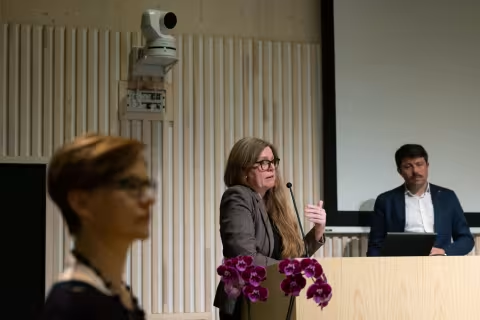
Opening keynotes by Professors Annelin Eriksen and Scott Bremer, here with Professor Birgit Kopainsky.

Every summer, Bergen Summer Research School gathers up to 100 PhD candidates from all over the world to a two-week research school in Bergen.

Academic speed dating to get going with the course on stress and mental health in education.