

HySchool Webinar #13: Mohamed Safy (UiO) & Duc Duy Nguyen (NTNU)
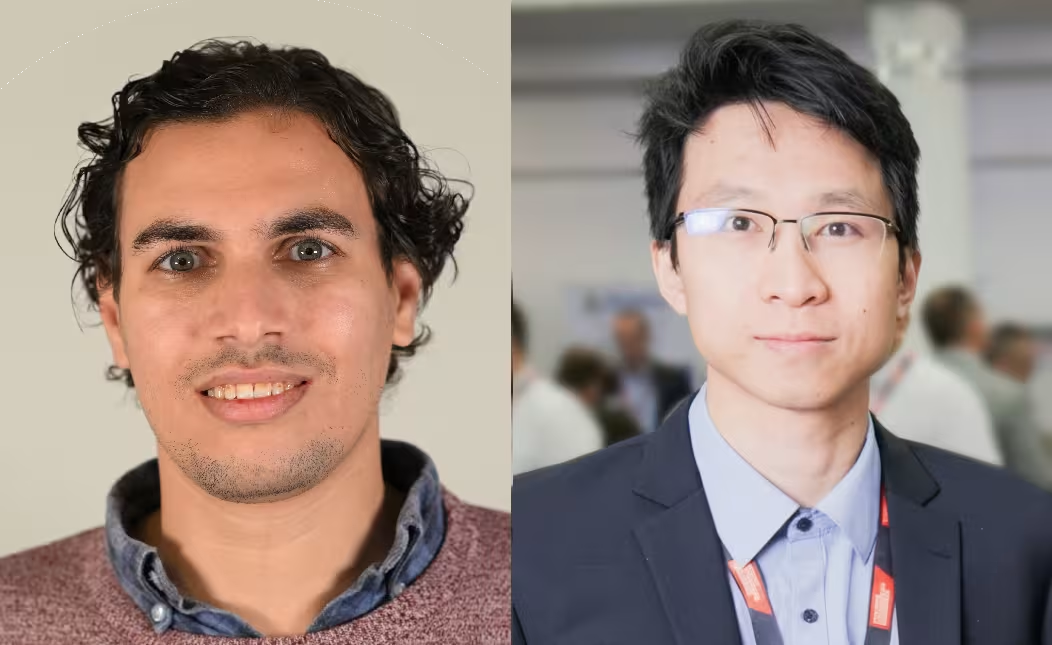
The next HySchool Webinar will take place on Teams at 13:00 CET on 18 November 2025. This webinar will feature PhD-candidates Mohamed Safy from UiO and Duc Duy Nguyen from NTNU. Each will deliver a 15-minute presentation followed by a Q&A session on their respective topics.
Mohamed Safy
PhD Candidate at UiO
From CO₂ to Methanol: How Amines Switch Catalysts On
Converting carbon dioxide into methanol provides a path to store clean energy and transform a greenhouse gas into a fuel and useful chemicals. Ru-MACHO-Ph is among the most effective and well-studied homogeneous catalysts for amine-assisted CO2 hydrogenation to methanol. Yet, key mechanistic details remain unclear, impeding the development of earth-abundant alternatives. Here, we employ a computational workflow that involves conformational searches using GFN2-xTB, followed by geometry optimizations and energy calculations with DFT (M06/M06L) and DLPNO-CCSD(T) to identify the most likely pathways for amine-assisted CO2 hydrogenation. Microkinetic modeling (MKM) predicts methanol turnover numbers (TONs) that match experimental results, allowing us to analyze the operative mechanisms and catalyst resting states. The analysis highlights that the thermodynamics of amidation are a crucial factor controlling the activity of amines in the methanol formation process. This thermodynamic driving force shifts the equilibrium away from formate resting states toward the active catalyst, thereby accelerating methanol formation. The correlation established between amidation free energies (ΔGamidation) and methanol productivity provides a rational design principle for tailoring amine promoters across Ru- and Mn-based MACHO catalysts. These insights advance the development of sustainable, base-metal-catalyzed CO2 conversion strategies, opening opportunities for integrated carbon capture and utilization.
Duc Duy Nguyen
PhD Candidate at NTNU
Ammonia lean burn combustion concept using hydrogen pre-chamber jet ignition: Optical investigation and combustion analysis
Ammonia is a promising alternative option for maritime applications. As a carbon-free energy carrier, when produced from renewable energy, creating a fully carbon-neutral pathway. Its high auto-ignition temperature, low flame speed, and narrow flammability limits make conventional spark ignition strategies inefficient or unstable. Pre-chamber jet ignition technology represents a promising alternative approach for enhancing ammonia combustion. The main objective of the work will be to determine a suitable injection strategy that achieves stable lean operation of an optical chamber equipped with hydrogen pre-chamber jet ignition system will be also determined. The experiment was conducted in an optically accessible compression ignition chamber (OACIC), which a custom-designed optical chamber placed to allow visual access to the combustion process. For all the tests, ammonia is the main fuel and was directly injected into the main chamber with hydrogen injected into the pre-chamber to serve as a combustion promoter. Hydrogen energy share was varied to evaluate the combustion characteristics under different operating parameters. Combustion visualization was performed using natural luminosity and chemiluminescence imaging to detect radical species such as OH*, NH*. The preliminary results demonstrate that stable lean combustion at an equivalent ratio of 0.6 can be achieved with pre-chamber hydrogen injection as low as 6% of the total fuel energy supplied. The data shows that there is more work to do to optimise the injection and spark timings, the testing campaign in the optical prechamber will be continued-examining the emissions from the exhaust gas and analysis of the mixture fraction in the pre-chamber.
Microsoft Teams
Join the meeting now (external link)
Meeting ID: 379 655 721 072 7
Passcode: Jz3Xj9Co