

The production of soapstone spindle whorls. An experimental approach
Last autumn I started work on my MA thesis, and I was lucky enough to have the opportunity to join the Borgund Kaupang Project. I will work with an exciting archaeological material, consisting of spindle whorls made of various materials from Borgund
By: Kristin Ersdal Edland
Published: (Updated: )

My thesis will discuss the production of spindle whorls of low-fired pottery. This production is unique in a Norwegian medieval context, because it appears likely that the whorls were produced locally and on quite a large scale in Borgund. I will write more about these spindle whorls later, starting this autumn, when I will take a closer look at my empirical material. This spring my task is to write an article relating to my thesis, which gave me the chance to do some experimental archaeology and explore how spindle whorls of soapstone could have been produced in medieval times.
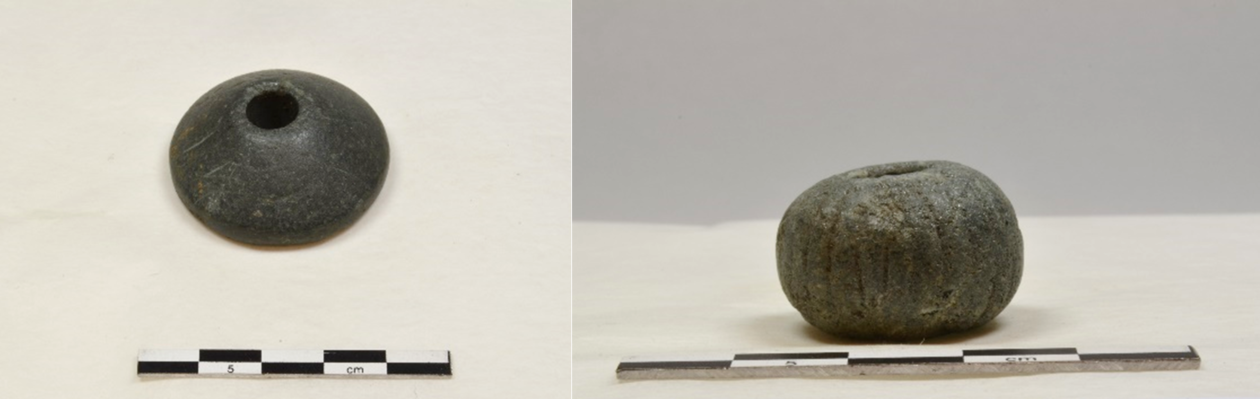
My hypothesis was that the beautiful and evenly shaped soapstone spindle whorls from Borgund (fig. 1) were made with a spring pole lathe, a primitive type of lathe without a flywheel. These spindle whorls appear to have been shaped with care, using a fine-grained soapstone. Among the artefacts from the same archaeological dig, I also found spindle whorls which were more coarsely made; these I hypothesised were made in a different way, maybe without a spring pole lathe. What I failed to consider was how the raw material, the rock itself, affected how the whorls could be formed. As a novice stonemason I assumed that soapstone is soapstone and that’s that. I could not have been more wrong! This has obliged me to revaluate my hypothesis, and with newly acquired knowledge more questions have emerged than got answered by my little experiment.
The first step of my experiment was to make a spring pole lathe. As you can see in my video (see link below), the lathe is not constructed with historically accurate methods and materials, rather it is made to fulfil the same function as medieval springpole lathes. In her book Craft, Industry and Everyday Life: Wood and Woodworking in Anglo-Scandinavian and Medieval York (2000), Carole A. Morris describes four essential attributes a spring pole lathe must have. These are: 1) two metal centre pivots which point toward each other on a horizontal plane that the turned material spins around; 2) a rope connected to a treadle that acts as the means of rotating the blank; 3) rigidity in the lathe, whether the lathe is permanently or temporarily set up; 4) a tool-rest which helps the craftsperson resist the great downward force subjected to the tool during turning. My spring pole lathe fulfils all these criteria, even though the set-up where my driving rope passes through a pulley to a birch-tree anchor further up the hill is less traditional than the flexible pole we see in illustrations from medieval manuscripts. This flexible, or springy, pole is what has given this type of lathe its name, and you can find a lot of interesting videos on the web explaining this tool in further detail. My video quickly shows what my lathe looks like and how it functions.
Making the spring pole lathe was a relatively quick and easy process, thanks to great help from my father, Hans Christian Rentsch. The following days of experimentation were more challenging. I experimented with roughly forming the soapstone into spindle whorls using chisels, gouges, and a rasp before mounting them in the springpole lathe. I quickly learned that turning the spindle whorl on the lathe was tricky. I don’t want to reveal my results in detail, as I plan to write an article on the experiment, but I will divulge that the rasp quickly became my favourite tool. With the rasp I was able to make a nice and even spindle whorl, even without the lathe. Two of my turned spindle whorls ended up splitting in two, which was a disappointment – until I discovered that the fragments looked a lot like fragmentary spindle whorls from medieval Bergen and Borgund. These arguments for and against the use of the springpole lathe will be interesting to explore further, and I will hopefully, based on my experiments, become wiser in the field of soapstone spindle whorl production.