

Glacier and climate
A glacier is a mass of snow and ice mainly located on land, which is or has been moving.
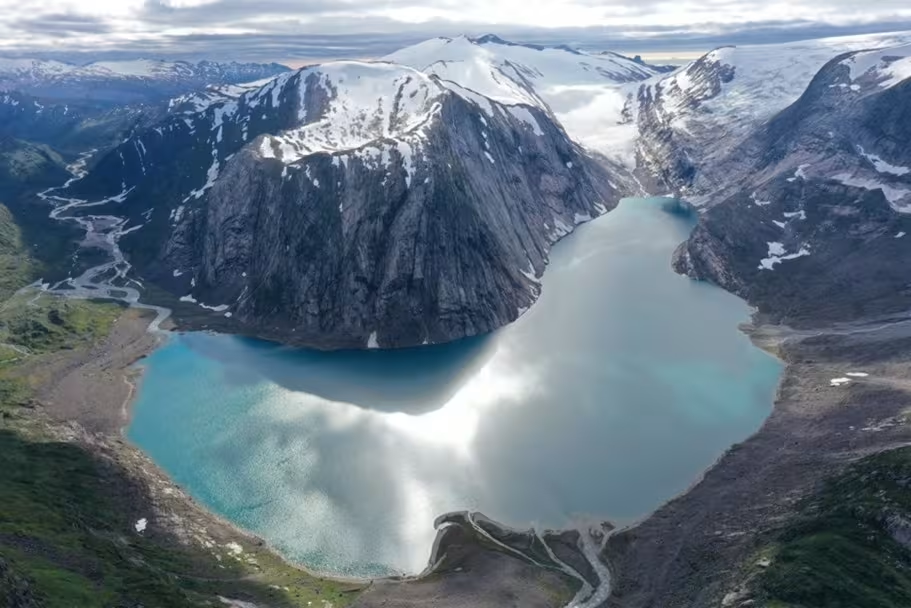
About the research topic
Glaciers depend on two main factors:
- Precipitation as snow during the year
- Summer temperature (in the ablation season)
For a glacier to form, more snow accumulates on the surface of the terrain than melts during summer. When this condition occurs, an ice cap can form. Additionally, cirque glaciers may form at lower elevations when additional wind-transported snow accumulates in larger terrain depressions. Changes in annual snowfall, summer temperatures, or prevailing wind directions will affect the glaciers. Glaciers will grow when more snow accumulates during winter than melts in summer, and vice versa. Changes in prevailing wind direction during winter can redistribute wind-blown snow, leading some smaller glaciers to disappear while others are established. Hence, glaciers are sensitive indicators of climate and can be considered «the canary» of the climate system because they record early changes.
The equilibrium-line altitude (ELA) of a glacier is the altitude where the annual accumulation of snow equals the melting at the end of the ablation season. At Norwegian glaciers in climatic steady state, there exists a close, non-linear (exponential) relationship (the «Liestøl equation») between annual snow accumulation and temperature during the ablation season. The ’Liestøl equation’ suggests that if either winter precipitation as snow (in water equivalent) or the temperature during the ablation season at the ELA is known, the other factor can be calculated. A proxy is data from a natural source of information that indirectly reflects variations in the phenomenon of interest. The «Liestøl equation» implies that if the former ELA is known, and an independent proxy for summer temperature is used in the calculation, variations in winter precipitation can be derived.

The prognosis for man-made climate change in this century indicates a «wilder and wetter» climate with warmer average air temperatures, increased precipitation, and more extreme weather. For Norway, this represents several challenges related to public safety in transportation, settlement, and the production and distribution of renewable energy, such as hydropower. By studying past and present changes in glaciers, we can obtain an early warning to help us understand and prepare for the near future.