

Lake Atitlán Lung Health Study, Guatemala
Harmful work environments are a global challenge, most prominent in deprived societies. New science suggests toxic exposures may affect germline cells and thereby health and disease in future offspring, and that father’s exposures may be as important as the mother’s. If true, radical rethinking of preventive strategies is needed - can also offspring benefit from improved work conditions in parents?

About the research project
This project brings together occupational health and epigenetic experts, anthropologists and local organizations, aiming to generate actionable knowledge on occupational and environmental exposures in indigenous communities in Guatemala and impact on the workers and their offspring’s respiratory health; and explore epigenetic mechanisms for transfer of exposure effects to offspring; with a research governance approach that builds trust and partnership with communities and stakeholders to ensure the research results can be acted upon. We study indigenous families in traditional Mayan villages in Guatemala.
Occupational and environmental exposure to dusts, endotoxins and chemical exposures (dyes, pesticides, plastic chemicals etc.) are measured in environmental samples, urine and blood. We will analyse how such exposures are associated with respiratory health of the workers, and how mothers and fathers’ exposures relate to growth/ height and respiratory health of their offspring. Epidemiological analyses will be supported and guided by mechanistic studies, of how parental exposures relate to offspring DNA methylation and to miRNA in sperm (fathers).
Citizens-led approaches are being applied to raise awareness among families while shaping policy processes at the local, national and global levels. This unique interdisciplinary project with a two-generation study in neglected population, unprecedented mechanistic work in humans and key partnerships, has the potential to generate high-level insights, relevant to policy and practice on all levels.
Project group meetings
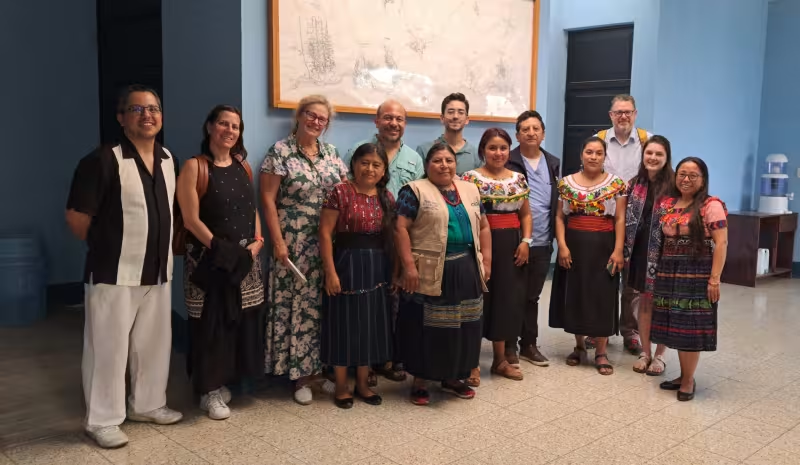
Meeting of project group with health centre in San Pablo la Laguna, February 2024.
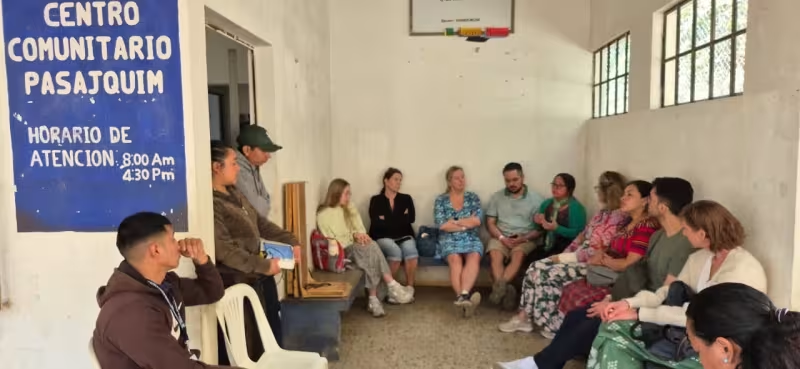
Meeting at health post in Pasajquim, San Juan, February 2026
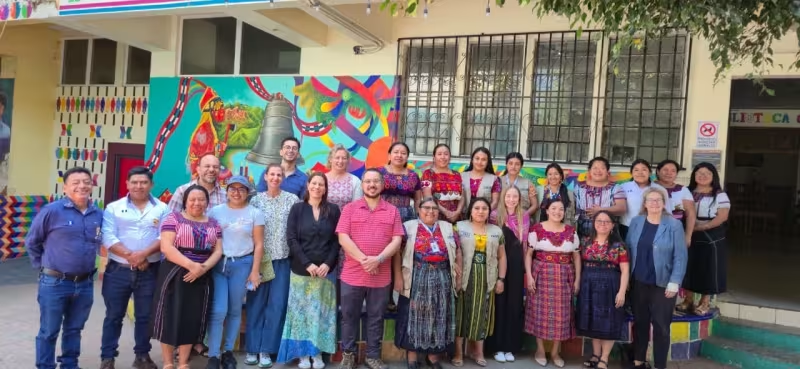
Project meeting with project group and health care centre, San Juan la Laguna, February 2026
The project’s scientific research title
Pesticides and exposures from traditional textile industry associated with own and offspring health in indigenous Guatemalan communities
Partner institutions
University of Bergen, Norway
Helse Bergen HF, Haukeland University Hospital (external link), Norway
Institute of Nutrition of Central America and Panama (INCAP) (external link), Guatemala
Centre for Equity and Governance for Healthcare, (CEGSS) (external link), Guatemala
CDRH Red de Defensores y Defensoras Comunitarios por el Derecho a la Salud (external link), Guatemala
People
Project manager
Cecilie Svanes Project manager
Project members
Manuel Ramirez Institute of Nutrition of Central America and Panama (INPCAP)
Benilda Batzin Centre for Equity and Governance for Healthcare (CEGSS)
Walter Flores Centre for Equity and Governance for Healthcare (CEGSS)
Randi Jacobsen Bertelsen University of Bergen, Norway
John Holloway University of Southampton
Ana Lorena Ruano University of Bergen, Norway
Juan Pablo Lopez Cervantes University of Bergen, Norway
Toril Mørkve Østergaard University of Bergen, Norway
Fernando José Jerez Pietropaolo University of Bergen, Norway
Master students
Tuva Harridsleff Ringheim
Marisa Swanson
Fernando José Jerez Pietropaolo Occupational and indoor chemical exposure in San Pablo la Laguna, Guatemala: A cross-sectional pilot study.
Rafael Federico Duran Galdo Food Insecurity and its relation to Socioeconomic Inequities, Food diversity and Obesity: A Cross-sectional Pilot Study among Indigenous Women in the Lake
Chloë Carpi Description of dietary patterns and food diversity in a selected sample of Maya women: a pilot field study in the Lake Atlitlán area, Guatemala.
Shokouh Makvandi-Nejad Prevalence of Allergic diseases in Mayan Population of Lake Atitlan, Guatemala: a cross-sectional pilot study.
Juan Pablo López Cervantes Asthma, Respiratory Symptoms and Lung Function in an Indigenous Mayan Population in Guatemala and Relation to Work in the Traditional Textile Industry
